Behind the Cage: Casino Cashiers on the Strange Psychology of Cashing Out
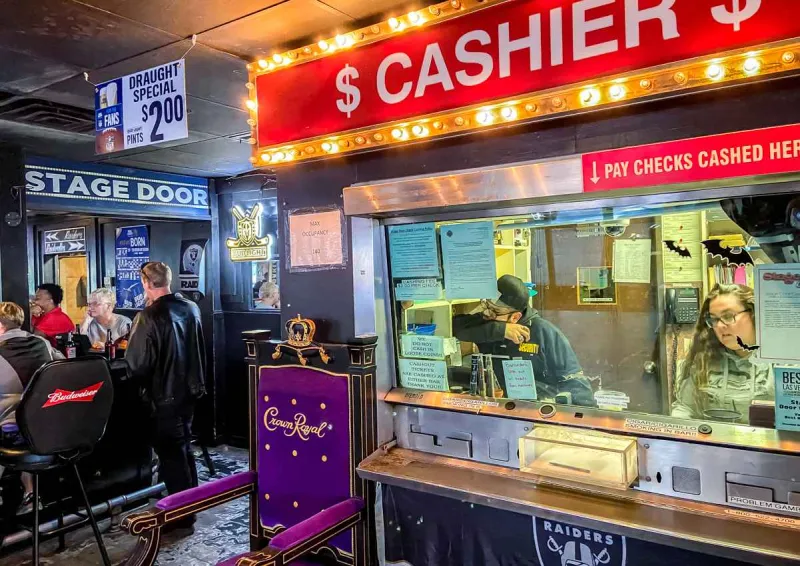
Photo: casino cashier cage window employee handing cash to player, via www.feelingvegas.com
The Two Minutes Nobody Writes About
Casino journalism loves the win. The hand-pay, the bell, the jackpot celebration photo with the oversized check. What almost nobody covers is what happens five minutes later, when the winner walks up to the cashier cage with a ticket, a bucket of chips, or a shoebox of cash and has to actually take the money home.
That's the moment, according to the people who work the cage, when gamblers get weird.
"People freeze at the window," says Dana, a cage cashier at a mid-size casino in the Reno market who asked us to use only her first name. "They'll stand there holding a ticket worth four thousand dollars and ask me if I think they should put it back in. I can't give advice. But I can see it on their face — that's not a question about money. That's a question about who they are right now."
We spoke with three current and former cage employees from properties in Nevada, Louisiana, and Pennsylvania. Their jobs sit at the intersection of banking and theater, and they've seen more human behavior in a single Friday shift than most of us see in a year.
Why Players Hesitate at the Window
The most consistent observation from every cashier we talked to: winners slow down right at the end.
"The longer the session, the heavier their feet get walking over here," says Marcus, who spent six years in a Gulf Coast casino cage before moving into casino operations. "A guy who's been up all night will redeem a $300 ticket like he's returning a defective toaster. But somebody who hit big early? They circle the floor first. They sit back down 'for one more spin.' The cage is the last chance for the casino, and some part of them knows it."
There's a name for this in gambling psychology circles — the pain of realizing a loss or, conversely, the pain of closing a win. Until the money is cashed, the outcome feels negotiable. The cashier window is where negotiation ends.
Dana puts it more plainly: "The ticket doesn't become real until I hand them the bills. I've watched people look at their own cash like it belongs to somebody else."
The Unusual Requests, Ranked by Frequency
Ask a cashier about their shift and you'll get stories. Here's the highlight reel, roughly in order of how often they occur:
The partial cash-out. "Cash me half, keep half on the machine." Cashiers can't do that — tickets are redeemed in full — but that doesn't stop dozens of players a week from asking, usually hoping the cage will somehow split fate's decision for them.
The lucky denomination. Players who want their winnings in specific bills. Nines and sixes come up more than you'd think, especially among regulars who play number-based systems. "I had a guy who wanted exactly $969 in cash every single time, no matter what he won," Marcus says. "If it came to $1,100, he'd play down $131 first. That's commitment."
The anonymity ask. Winners who want to know if the win will be reported, who it's reported to, and whether their spouse will find out. (Cashiers can't help with the marriage, only the W-2G.)
The superstition redemption. Tickets redeemed at a specific time of day, or refused until a clock strikes a certain minute. One cashier recalls a player who wouldn't redeem anything between 9:00 and 9:10 in the evening — "bad window," apparently.
The tip confusion. Table game players know about toke boxes; slot players often don't realize that hand-pay jackpots customarily involve a tip to the attendant. Cashiers absorb a lot of awkwardness on this one.
What Cashiers Wish You Knew
Every person we spoke with had a short list of things they'd tell players if the glass between them wasn't there.
Sign your ticket early. Tickets above a certain threshold require ID and a signature. Doing the paperwork at the window while a line forms behind you is nobody's idea of a victory lap.
Don't announce your total in line. Cage areas have their own security dynamics. Discretion is free.
Ask about the paperwork before you need it. Federal reporting thresholds, state withholding for large wins, the difference between a W-2G and a 1099 — cashiers answer these questions all day. A two-minute conversation can save you a tax-season headache.
And the big one: the cage isn't the enemy. "People act like I'm the house," Dana says. "I'm not the house. I'm the only person in this building whose whole job is giving you your money."
The Walk-Away Problem
The most poignant theme across all three interviews wasn't about procedures. It was about the players who never show up at the window at all.
"You can watch a win die," Marcus says. "Guy hits $2,000 on a progressive, cashes the ticket, and you can see him doing the math on the walk over. By the time he reaches the cage, he's already turned around. Two hours later the ticket's dust."
Dana agrees, and adds a nuance: the winners who cash out fastest are often the smallest spenders. "The $200-a-visit crowd? They hit the window, they're gone, they're at Denny's. It's the people chasing back a big loss who can't complete the last hundred feet."
Her advice, which she's not technically allowed to give: "Decide your number before you sit down. Whatever it is — $969, $50, whatever means something to you — the window is where the decision gets honored. Not the machine."
The Last Human Transaction
As casinos push toward cashless wagering and app-based wallets, the cage itself is shrinking. Some newer properties have half the window positions they did a decade ago. The cashiers know what's coming.
"Everything's going digital, and honestly, it'll be faster," Marcus says. "But there's something about a person handing you money that a screen can't do. It makes the win finish. I've had players tell me the cash in hand is the only part they remember a week later."
The ritual may be fading, but for now, somewhere on a casino floor in Nevada or Pennsylvania, a winner is circling the floor with a ticket in their pocket, working up the nerve. And behind the glass, a cashier is waiting — ready to make it real.