One Month of $9.69 Bets: The Ledger, the Lore, and What I Learned Forcing Every Wager to Match My Brand
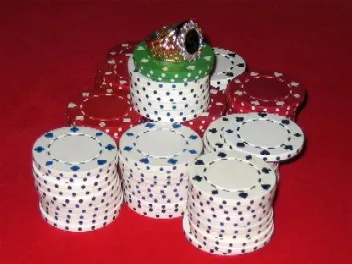
Photo: Dannyzumwalt at English Wikipedia, CC BY-SA 3.0, via Wikimedia Commons
Every gambler has that one number. Mine, given where I write, was always going to be 9.69. So I decided to find out what happens when you refuse to bet anything else — no $10 blackjack, no $1 spins, no $20 parlays. For thirty days, every single wager I made was exactly nine dollars and sixty-nine cents.
The rules were simple: slots at $9.69 a spin, blackjack at $9.69 a hand (with winnings re-bet at whatever the math demanded), and sports wagers rounded to $9.69 in units. No exceptions, no cheat days, no 'just this once' $25 bets because the game felt right.
Week One: The Awkwardness Phase
The first thing I learned is that casinos — real and online — are not built for the number 9.69. Live blackjack got me more side-eyes than a guy in sunglasses at 2 p.m. Dealers would announce "sixty-nine" and someone at the table would chuckle. Every time. Without fail.
Online, the awkwardness turned logistical. Most sportsbooks let me enter custom stakes, but a few rounded my bets. One app auto-corrected $9.69 to $9.70, and I had to decide whether that violated my own experiment. I ruled it a rounding error, not a betrayal. Your mileage may vary.
What surprised me most in week one was how much mental bandwidth the constraint freed up. Normally, I'd agonize over stake size — bump it up after a win, trim it after a loss. With the number fixed, all that decision-making evaporated. I just played.
Week Two: Discipline or Superstition?
By day ten, I couldn't tell anymore whether I was running a bankroll system or performing a ritual. The distinction started to blur.
There's real math behind flat betting — it's the backbone of every serious bankroll guide. Fixed stakes slow the bleed during losing streaks and keep you from chasing. But 9.69 isn't a calculated percentage of my bankroll. It's a brand joke. Somewhere along the way, the joke started to feel like a talisman. When I hit a nice win on a $9.69 spin, my brain whispered that the number was "hot." That's nonsense, of course. The RNG doesn't know my URL.
And yet — and this is the part that surprised me — the nonsense had a function. Because the number felt meaningful, I respected it. I didn't break the streak. A boring flat bet with a silly number attached did a better job protecting my bankroll than my usual 'adaptive' staking ever did, mostly because 'adaptive' was a euphemism for emotional.
The Blackjack Problem
Slots absorbed $9.69 without complaint. Sportsbooks tolerated it. Blackjack nearly broke the experiment.
Basic strategy assumes a flat bet, so that part was fine. But doubling down? Splitting? Splitting once at $9.69 means $19.38 on the felt, which violates the letter of the rule. I gave myself a carve-out: derived bets — doubles, splits, insurance — could be whatever the game required, but every initial wager stayed at 9.69. Purists will note this makes it a 'base stake' experiment, not a pure one. I can live with that.
The Final Ledger
Thirty days, 412 slot spins, 187 blackjack hands, and 23 sports wagers. Here's the honest math:
- Slots: Down about $310. Expected, given the volatility of the games I picked.
- Blackjack: Up $84. A genuinely decent run of cards, nothing more.
- Sports: Down $41. Two parlays died in heartbreak fashion, as parlays do.
Net result: roughly negative $267 for the month. Which is, honestly, cheaper than most of my entertainment options in 2025, and far cheaper than the months when I 'adapted' my stakes freely.
What the Number Actually Bought Me
The money wasn't the point. The point was what the constraint did to my behavior:
- I played longer on less. Fixed small stakes stretched my bankroll across the whole month instead of torching it in three sessions.
- I stopped tilt-betting. There was no 'one big bet to get it back' option. The number was the number. Tilt had nowhere to go.
- I quit sessions easier. Without stake escalation as a lever, losing streaks felt like weather, not failure.
Would I recommend $9.69 specifically? Only if you work here. But the structure — one fixed, slightly absurd stake you're unwilling to negotiate — is a genuinely useful tool. It converts willpower from a moment-to-moment battle into a single decision you make once.
Superstition? Sure, a little. But if a dumb number is what stands between your bankroll and your worst impulses, I'd call that a lucky number worth keeping.